
Top Ways to Disguise Bins Around Your Garden
- nelsonscott100
- Aug 1
- 6 min read
A well-kept garden can lose its charm surprisingly quickly when a row of plain plastic wheelie bins sits beside the gate, patio or flower beds. The top ways to disguise bins are not just about hiding them away - they are about making an everyday necessity feel more at home in the space you have worked hard to create.
For most households, the right choice comes down to location, access and how much maintenance you are prepared to take on. A bin must still be easy to wheel out on collection day, simple to clean around and able to cope with rain, frost and strong sunshine. Here are the options that genuinely work for British gardens.
1. Transform bins with weatherproof wheelie bin covers
A fitted adhesive cover is often the simplest way to improve the appearance of a wheelie bin without changing where it lives. Rather than building a structure or sacrificing valuable garden space, you turn the bin itself into a more attractive feature.
Nature-inspired prints work particularly well beside fences, patios and planted borders. Floral designs can soften the hard lines of a large 240L bin, while foliage, meadow and garden-themed patterns help it sit more quietly against greenery. It is a practical solution for front gardens too, where bins may need to remain near the driveway or side entrance.
The quality of the material matters. A cover designed for outdoor use should be made from weatherproof vinyl, printed with fade-resistant inks and finished with a dependable adhesive that will not give up after a few wet weeks. The best kits are sized for standard 140L, 180L and 240L wheelie bins, so the design looks considered rather than improvised.
At The Wheelie Bin Cover Company, four self-adhesive sheets and a squeegee are supplied with each kit, allowing homeowners to achieve a neat result without specialist tools. Clean, dry panels and a little care while smoothing out air bubbles are usually all that is needed. It is a small job with an immediate visual payoff.
2. Use planting to soften the view, not block access
Plants are one of the most natural ways to disguise bins, but they are most effective when used to frame the bin area rather than completely surround it. A deep border in front of a bin position can break up the view from the garden while leaving room behind for the lids to open and the bins to be moved.
Evergreen shrubs offer coverage throughout the year, while ornamental grasses bring movement and texture without creating a heavy barrier. If the bins sit against a wall or fence, a trellis with climbers can also draw the eye upwards. Choose plants that suit the light levels and remember that vigorous climbers need regular trimming to prevent them from taking over bin handles and lids.
Planting alone can be less successful beside a front path or tight side passage. It takes time to establish, can look sparse in winter and may make collections more awkward if it grows into the access route. Pairing a planted border with decorative bin covers gives the area a finished look from day one, while the greenery grows in around it.
3. Build a simple timber screen
A timber screen is a classic choice for homeowners who have a fixed bin area and enough room to create a visual barrier. Slatted timber panels look clean and contemporary, while a more traditional fence-style screen can blend into an established cottage garden.
The key is to leave clearance around the bins. Measure the width of all the bins together, then allow extra room for opening lids, pulling them out and walking behind them. A screen that looks smart but forces you to drag a heavy bin sideways every week soon becomes a nuisance.
Timber needs attention to stay attractive outdoors. Use treated timber, keep the base away from standing water and plan to refresh the protective finish when needed. In a sheltered back garden this may be a worthwhile long-term feature; in a narrow, exposed side return, a bin cover can be the more convenient and lower-maintenance answer.
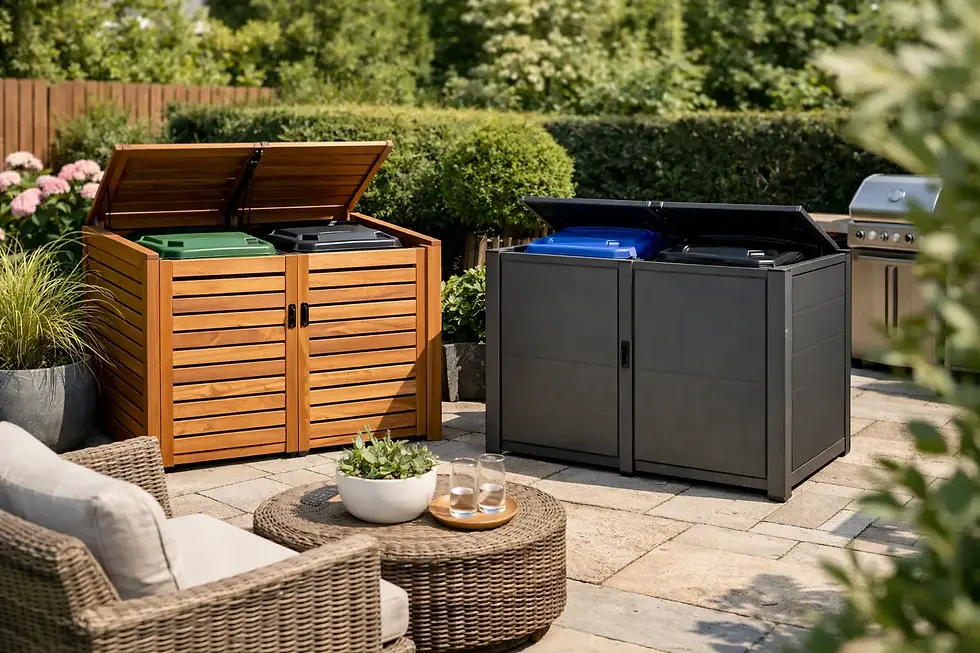
4. Choose a purpose-built bin store where space allows
A bin store is useful when you want a fully enclosed solution, especially if bins are visible from the road. Available in timber, metal and recycled plastic, these units can conceal one, two or three bins behind opening doors and a lifting top.
Before choosing one, think beyond appearance. Check that its internal dimensions accommodate your exact bin size, including the lid height. Make sure doors open wide enough to remove the bins comfortably and that the top is easy to lift when putting rubbish in. A store should make everyday routines easier, not turn them into a weekly wrestle.
There are trade-offs. Large stores take up a considerable footprint and may need a level base. Cheaper versions can rattle in windy weather, while wooden styles require maintenance. They are an excellent choice for a permanent, spacious bin bay, but not always the best fit for compact gardens or rented homes.
5. Create a screened side passage
The side of a house is often the natural home for wheelie bins, yet it can become the first thing you see when coming through the gate. A short section of matching fence panel, a decorative trellis or a narrow outdoor screen can hide the view from the main garden without enclosing the whole passage.
Keep the route clear and well drained. Wet leaves, loose gravel and cramped turns make it harder to manoeuvre a full bin, particularly during winter. If the passage is exposed, choose a screen that is securely fixed and avoid placing anything loose where it could blow over.
This approach is especially effective alongside a coordinating wheelie bin design. The screen handles the sightline from the garden, while the cover improves the view whenever the bins are pulled out for collection day.
6. Make a feature of the bin area
Sometimes hiding bins completely is unnecessary. If their location cannot be changed, the more realistic aim is to make the area look intentional. A neatly edged gravel pad, a painted fence panel, a pair of large planters and a decorative bin cover can turn a forgettable corner into an organised part of the garden.
This works best when you repeat colours and materials already used elsewhere. For example, a sage-green fence, terracotta pots and a botanical bin design will feel far more connected than a random screen added as an afterthought. The result should look like part of the garden scheme, not a desperate attempt to conceal household clutter.
Practical details still matter. Leave a firm surface beneath the bins so wheels do not sink into soil, and avoid placing them directly against delicate plants. Check that drainage is good, as dirty water can collect beneath bins after rain.
How to choose the right bin-disguising solution
Start by standing where you most often notice the bins: at the kitchen window, from the patio, by the front door or when entering through the garden gate. That viewing angle tells you whether you need to improve the bins themselves, create a partial screen or invest in a full enclosure.
Then consider collection day. If bins must travel down a narrow route, bulky stores and dense planting can create more problems than they solve. A weatherproof cover is particularly useful in these situations because it adds colour and character without taking up another inch of space.
Finally, choose an option that suits the care you want to give it. Mature planting and timber screens can be beautiful, but both need ongoing maintenance. A well-made vinyl wheelie bin cover offers a straightforward, durable improvement for homeowners who want their garden to look cared for in every season.
A few practical questions
Will a wheelie bin cover survive British weather?
A premium outdoor vinyl cover with strong adhesive and fade-resistant printing is made to withstand rain, sun and everyday use. Preparation is vital: apply it only to a clean, dry bin surface and smooth each section carefully for the best adhesion.
Can I use a bin store with a decorative cover?
Yes. A cover still improves the look of the bins when doors are open, on collection day or when a bin is temporarily left outside the store. It also gives you more flexibility if you later move the bins to another location.
What is best for a small garden?
For limited space, avoid structures that make access difficult. Decorative covers, a narrow screen and carefully placed planters usually provide the strongest result without crowding paths or patios.
Your bins will always have a practical purpose, but they do not have to be the least attractive part of the garden. Choose the solution that keeps collection day easy, withstands the weather and gives you a view you are happier to come home to.


Comments